GPT-6 Luna vs GPT-6.1 Sol: 14 Times the Price, What Does Sol Buy?
Two OpenAI models, one board deck, the same data and the same pipeline. The bigger model costs 14 times as much per deck. Here is what the difference actually got us.
Sol costs 14 times as much per deck ($2.08 against 15 cents) and is faster (5.4 minutes against 8.6). What it buys is analysis: campaign efficiency and loss reasons over time, where Luna summarized where the money went. Sol found 3 of 8 story points in our checklist, Luna 1. Neither reached the Southeast win-rate story.
At a glance
| GPT-6 Luna | GPT-6.1 Sol | |
|---|---|---|
| Billed cost | $0.15 | $2.08 |
| Build time | 8.6 min | 5.4 min |
| Analysis calls | 47 | 33 |
| Content slides | 11 | 11 |
| Stories found | 1 of 8 | 3 of 8 |
| Meta prospecting | Where the money went | Cost up 50%, conversions flat |
| Southeast | The decline, not the reason | Not covered |
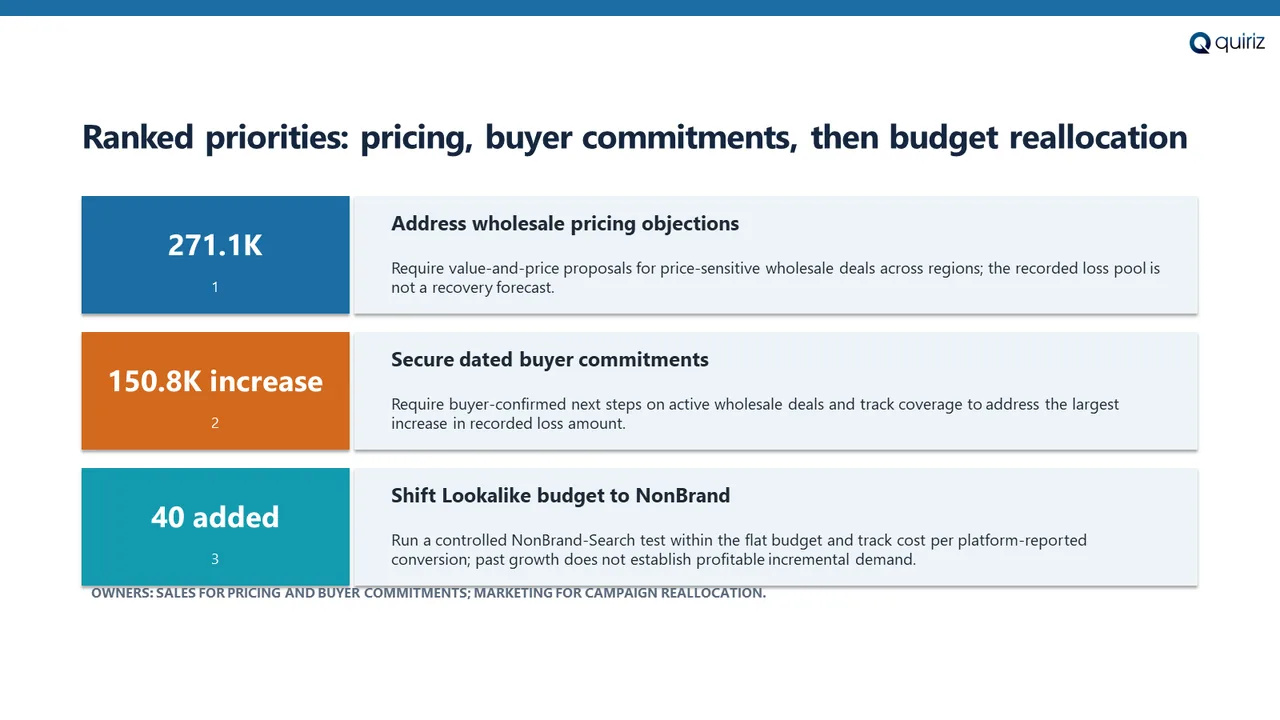
| Recommendations | Back the growing regions | Pricing, buyer commitments, a NonBrand test |
Where they agree
Both decks lead with the same shifts: Prospecting-Lookalike took 82.3% of Meta’s added spend and PMax-Retarget 61.2% of Google’s, and wholesale won amount rose $299K.
What the extra $1.93 bought
- Efficiency, not just spend. Sol set conversions against cost for every campaign: Lookalike cost up 50% with conversions flat, NonBrand-Search conversions up 21.4% on 12.1% more cost. Luna stopped at where the money went.
- Loss reasons over time. Sol showed pricing losses up $104.7K and deals going dark up $150.8K year over year.
- Recommendations a board could use. Luna recommended more effort on the two regions already growing; Sol ranked three specific actions with owners.
What neither found
The Southeast won 4 of its 20 closed deals in 2026, against more than half everywhere else, and lost mostly on price. Luna reported the Southeast decline without asking why. Sol looked at losses by region, saw them roughly even, and did not set them against wins. Claude Opus 5.5 found it in one slide.
Verdict
If the deck is a summary you will annotate yourself, Luna at 15 cents is fine. If the deck is the analysis, Sol is clearly better and faster. But on this test the better buy below $1 is neither: DeepSeek V4.1 Flash found more than Sol for 30 cents.
More from this test
- All models, one board deck: the full results
- What an AI board deck really costs, by model and by step
- DeepSeek V4.1 Flash · GPT-6.1 Sol · GPT-6 Luna · Gemini 3.8 Flash
- GPT-6 Luna vs Sol · DeepSeek vs GPT-6.1 Sol
Run the same deck on your own data
Describe the deck in PowerPoint and see the source of every figure. Free to start.
Try Quiriz free →