AI Model Benchmark 2026: 10 Models, One Board Deck
Most model benchmarks are puzzles and exams. This one is a job: turn a company’s ad and sales data into a board deck with a summary and recommendations. We know the stories in the data, so we can say which model found them, what it cost and how long it took.
Claude Opus 5.5 wrote the best board deck, for $11.10: it found the most and tied it into one story. DeepSeek V4.1 Flash came in at 30 cents and found the biggest ad problem in the data. GPT-6.1 Sol was the fastest at 5.4 minutes. GPT-6 Luna was the cheapest at 15 cents and the lightest on analysis. Seven models finished their decks; we compared the six we have in hand on cost, speed and what each one found. The rest of this page is how we ran it and what each model did.
How a Quiriz deck is built
Make a Deck in the PowerPoint add-in works the way an analyst would, in five steps. In this test the model under test ran every one of them.
- Plan. The model reads the request, the descriptions of the company’s connected datasets and its metric definitions in Company Context. It names the decision the deck supports and who it is for, then proposes the storyline: one question per slide, each tied to the data that can answer it. The plan waits for a person to approve it, so its time is left out of the build times below.
- Build. Each slide’s question is answered from the data. The model writes a query against the connected datasets, reads the result and queries again if it needs to, using the company’s own metric definitions where they exist. A grounding check stops it filtering on values the data does not contain, and a chart is drawn from each answer. This is where the analysis happens, and it is most of the cost.
- Gap analysis. The model reads the finished answers as a set and looks for what they leave unexplained: a campaign whose return fell, a region that moved against the rest. It adds drill-down questions to explain them, for up to two rounds, and those are answered the same way.
- Write. From the answers alone, the model writes each slide’s title and the observations under its chart, the executive summary at the front and the recommendations at the end. Figures in the prose are checked against the rows, and a sources slide lists how every figure was produced.
- Critic. The model reads its own draft the way a senior partner would: does the bottom line answer the decision, is every recommendation specific and sized by a figure from its own slide, are any two recommendations the same move, does each finding say what its figures mean. It rewrites the parts that fail, and its figures go through the same checks as the writer’s. To keep a deck within a few minutes, the critic runs only when the writer finished within two minutes.
Chart styling, question routing and the grounding check run on the same small models for every run, so the comparison isolates the model doing the planning, analysis, writing and review.
Results
| Model | Billed cost | Build time | Answer calls | Stories found (of 8) |
|---|---|---|---|---|
| Claude Opus 5.5 | $11.10 | 8.4 min | 41 | 7 |
| Gemini 4 Argon | $2.98 | 13.6 min | 45 | 6 |
| DeepSeek V4.1 Flash | $0.30 | 8.2 min | 67 | 5 |
| GPT-6.1 Sol | $2.08 | 5.4 min | 33 | 3 |
| GPT-6 Luna | $0.15 | 8.6 min | 47 | 1 |
| Gemini 3.8 Flash | $1.47 | 13.8 min | 59 | 1 |
| Kimi K3.1 Pro | $4.01 | 8.1 min | 47 | scored in an update |
Billed cost covers the whole run, from the plan to the last slide. Answer calls are the analysis steps the model chose to take; more calls is not better, it is just more. The stories are below.
What each deck found
Northvale’s data has stories planted in it, so a good board deck should find them and act on them. Two points for a full find, one for a partial, none where the deck did not cover it:
| Story | Opus 5.5 | Argon | DeepSeek | Sol | Luna | 3.8 Flash |
|---|---|---|---|---|---|---|
| Meta prospecting (Prospecting-Lookalike) stopped paying for itself from May | 1 | 1 | 2 | 1 | 0 | 0 |
| The Southeast’s win rate fell to 20% while other regions held about 52% | 2 | 1 | 1 | 0 | 1 | 1 |
| Price is what the Southeast loses on | 2 | 2 | 0 | 1 | 0 | 0 |
| The recommendations act on those stories | 2 | 2 | 2 | 1 | 0 | 0 |
| Total (of 8) | 7 | 6 | 5 | 3 | 1 | 1 |
None of the six plans included Northvale’s online store, so its stories (August as the best month, a T-shirt that runs small) are not scored. Every model made that same planning choice, and it shows something useful: the plan, not the writing, decides what a deck covers.
What each model did
Claude Opus 5.5: the best story ($11.10)
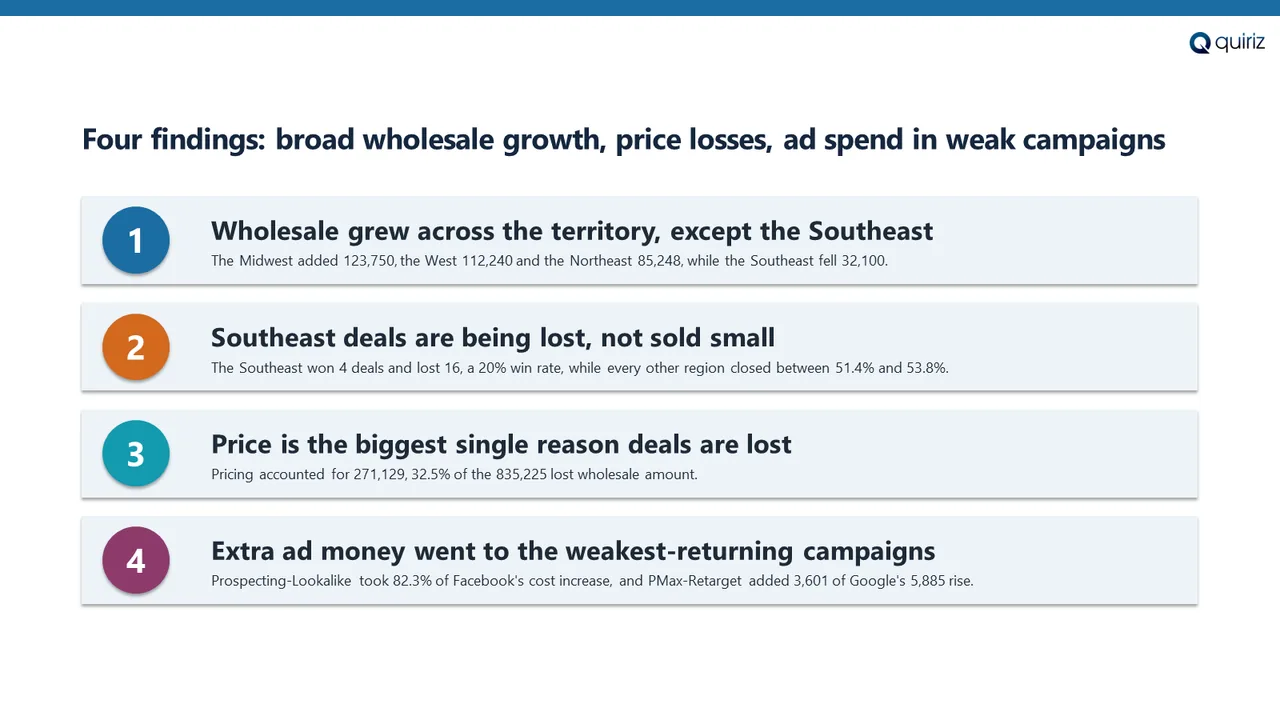
The only deck that tells one connected story: wholesale grew everywhere except the Southeast; the Southeast won 4 deals and lost 16, a 20% win rate against 51% to 54% elsewhere; price is the biggest reason deals are lost, 32.5% of lost value; and the extra ad money went to the weakest campaigns. Its four recommendations follow directly: a regional price answer for reps starting in the Southeast, a cap on Prospecting-Lookalike, a move from PMax-Retarget to Brand-Search, and more Southeast sales coverage. The critic step did not run on this deck (it runs only when writing finishes within two minutes), so this is the writer’s first draft.
Gemini 4 Argon: thorough and long ($2.98)
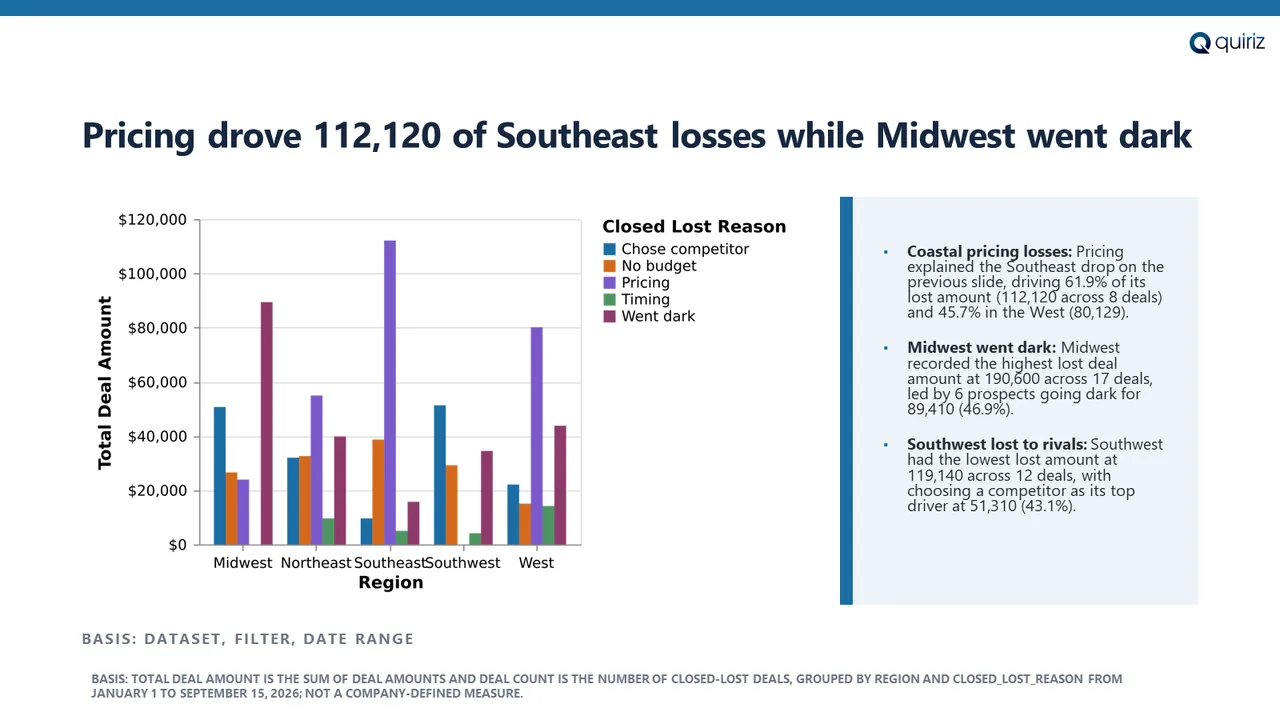
Twenty-two slides and the deepest drill-downs: Southeast losses were 61.9% on price, Midwest losses were mostly deals that went dark, and Lookalike conversion value fell in both ad sets while cost rose. Its recommendations are specific and sized: regional pricing tiers for the Southeast and the West, Midwest follow-up, a Lookalike pullback and a move from PMax to Search. The one weaker call is where the Lookalike money goes: into a promotion that spent about $1,000 all year.
DeepSeek V4.1 Flash: the ad story, for 30 cents
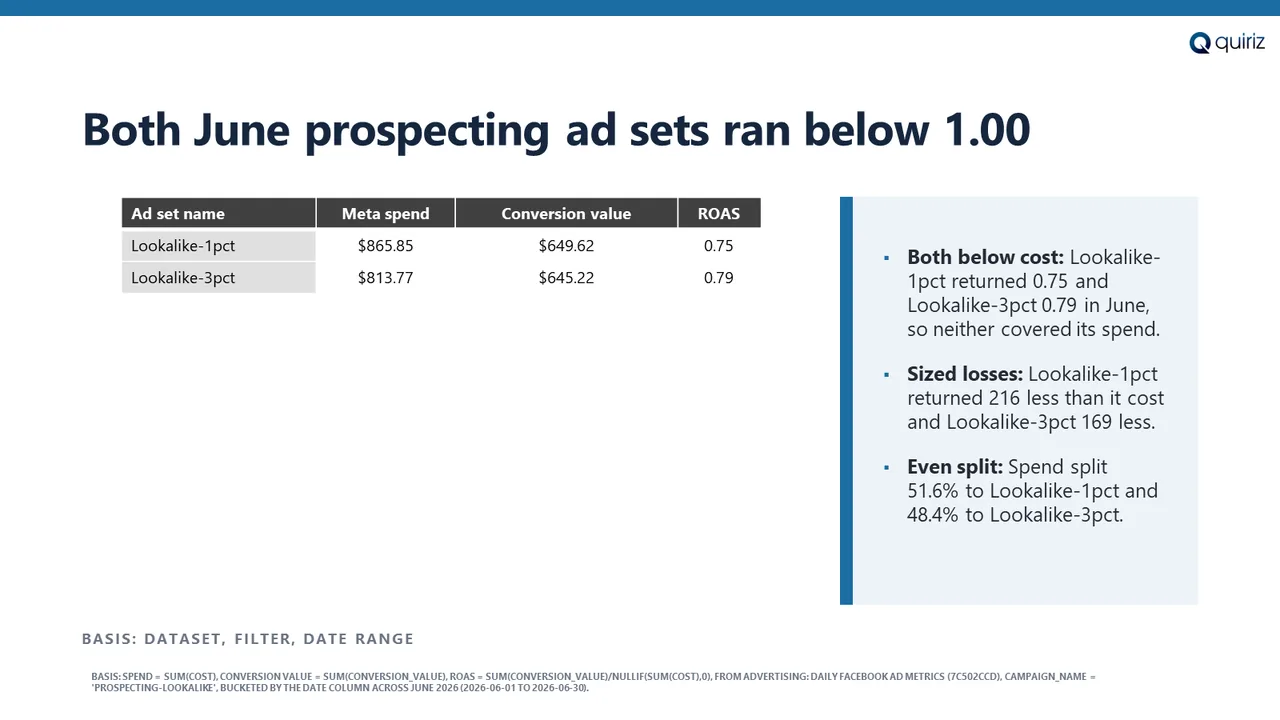
The best ad analysis of the six: it followed Meta returns month by month and found both Lookalike ad sets below 1.00 in June, returning $385 less than they cost. Its recommendations are sequenced by month, starting with cutting that campaign. It did not single out price as the Southeast’s problem. Full DeepSeek review.
GPT-6.1 Sol: fastest, most cautious ($2.08)
Built in 5.4 minutes, with careful labels on every figure. It caught Lookalike cost up 50% with conversions flat, and ranked loss reasons year over year, but it did not look at win rates by region, so the Southeast story is not in its deck. Full Sol review.
GPT-6 Luna: 15 cents, and light
A clean summary of where the money went and which regions grew, and little beyond it: no campaign returns and no reasons behind the regional change. Its one recommendation is to put more effort into the two regions already growing. Full Luna review.
Gemini 3.8 Flash: slowest, and broad rather than deep ($1.47)
A tour of the figures: wholesale won amount, Google campaigns by conversion value, Meta audiences and placements. It did not follow the Meta prospecting decline or regional win rates, and its recommendations follow the regions and campaigns already doing best. Full Gemini 3.8 Flash review.
Where the money goes
On every model, the Build step, answering the questions behind the slides, was 65% to 86% of the bill. Writing the slides and their notes cost under a dollar on every model, and the critic a few cents. The Opus answers cost $9.54 of its $11.10. Every other model’s bill came in 12% to 54% under list price thanks to automatic prompt caching; Anthropic models cache only what a request marks, and Quiriz now marks it, so Opus decks cost less from here. More in what an AI board deck really costs.
Not in this round
GPT-6 Astra and Claude Sonnet 5.5 hit their providers’ rate limits during their runs, and Qwen 3.8 Max Prime did not complete a plan. We will rerun them and add them here.
Which model to pick
- Board meeting, money no object: Claude Opus 5.5.
- Nearly the same depth for a quarter of the price: Gemini 4 Argon.
- A monthly deck you will review yourself: DeepSeek V4.1 Flash. At 30 cents you can run it twice and compare.
- A quick summary rather than an analysis: GPT-6 Luna or Gemini 3.8 Flash.
The data
Every run as a CSV: cost by step, tokens, analysis calls, build time and list prices. Northvale is a fictional company. If you write about these results, link this page: we will add each rerun and each new model to it.
More from this test
- All models, one board deck: the full results
- What an AI board deck really costs, by model and by step
- DeepSeek V4.1 Flash · GPT-6.1 Sol · GPT-6 Luna · Gemini 3.8 Flash
- GPT-6 Luna vs Sol · DeepSeek vs GPT-6.1 Sol
Run a board deck on your own data
Connect your ad accounts and CRM, describe the deck in PowerPoint, and see the source of every figure. Free to start.
Try Quiriz free →