GPT-6.1 Sol Tested on a Real Board Deck
Sol reads like a careful analyst: every figure labeled, every limit stated. That makes it easy to trust and slow to commit, and the biggest sales story did not make its deck.
GPT-6.1 Sol built an 11-slide review in 5.4 minutes for $2.08, the fastest of seven models. Every figure is carefully labeled and every comparison uses the same dates each year. It caught the rising cost of Meta prospecting, but did not look at win rates by region, so the Southeast story is missing. It found 3 of 8 story points in our checklist.
The run
| Billed cost | $2.08 ($1.66 answers, $0.14 slide notes, $0.12 writing and critique) |
| Build time | 5.4 minutes (fastest of seven) |
| Analysis calls | 33 (fewest of seven), reading 1.4 million input tokens |
| Slides | 11 content slides |
| Stories found | 3 of 8 (see the checklist) |
What it found
- The Lookalike cost problem. Prospecting-Lookalike took 82.3% of the added Meta spend, cost up 50% while conversions stayed flat, and cost per conversion rose in every placement of both ad sets.
- Google efficiency. NonBrand-Search conversions grew 21.4% on 12.1% more cost, while PMax-Retarget’s 165% cost rise outran its conversions.
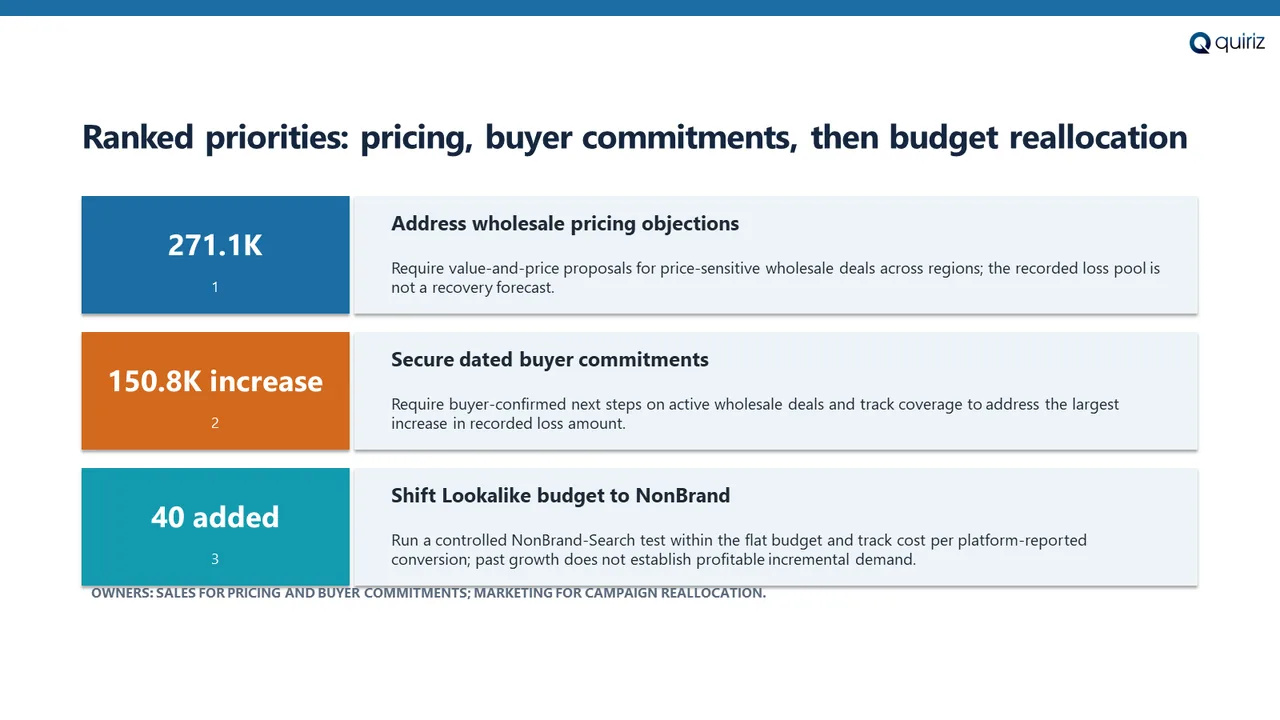
- Loss reasons over time. Pricing losses up $104.7K to $271.1K, and deals going dark up $150.8K, the largest increase.
- Careful labels. Ad conversions are called platform-reported throughout, and the deck says what the selected data cannot answer.
What it left out
The Southeast. Sol ranked lost deal amount by region, found the regions close, and concluded that losses were too spread out to concentrate sales coverage. It never set losses against wins: the Southeast won 4 of its 20 closed deals while every other region won more than half. That is the biggest sales story in the data.
Its recommendations
Three, ranked: require value-and-price proposals on price-sensitive deals; require dated buyer commitments to stop deals going dark; run a controlled test moving Lookalike budget into NonBrand-Search. All three are reasonable and properly hedged. None targets the Southeast, and the media one stops short of cutting a campaign its own slides show losing efficiency.
The slide notes
The most precise of any model: each observation states its basis and its limit. The trade-off is tone. Phrases like “does not establish profitable incremental growth” are careful and leave a board without a verdict.
Verdict
The analyst you trust not to overstate, and the fastest. If you want it to find the problem and say what to do, Claude Opus 5.5 did both. For cheaper comparisons see GPT-6 Luna vs Sol and DeepSeek vs GPT-6.1 Sol.
More from this test
- All models, one board deck: the full results
- What an AI board deck really costs, by model and by step
- DeepSeek V4.1 Flash · GPT-6.1 Sol · GPT-6 Luna · Gemini 3.8 Flash
- GPT-6 Luna vs Sol · DeepSeek vs GPT-6.1 Sol
Build a board deck from your own data
Describe the deck in PowerPoint and Quiriz answers each slide from your connected data. Free to start.
Try Quiriz free →