Why AI Gives You a Different Number Every Time
Ask a generic AI "what is our win rate" twice and you can get two answers — because it guesses what "win" means each run. For finance and ops that is disqualifying. Here is the fix: define your metrics once, so the same question always returns the same number.
The data doesn't change between runs. The definition does. Ask a generic AI "what's our win rate" without saying what "won" means, and it guesses — differently each time. The fix isn't a smarter model; it's writing your definitions down once.
Why the number moves
"Revenue" — gross or net? "Overdue" — past due at all, or past due by 60 days? "Win rate" — over closed deals, or all deals? Every ambiguous term is a fork the model takes on its own, and it can take a different fork on the next run. On a spreadsheet full of undefined terms, a confident answer is not the same as a reproducible one.
The fix: define it once
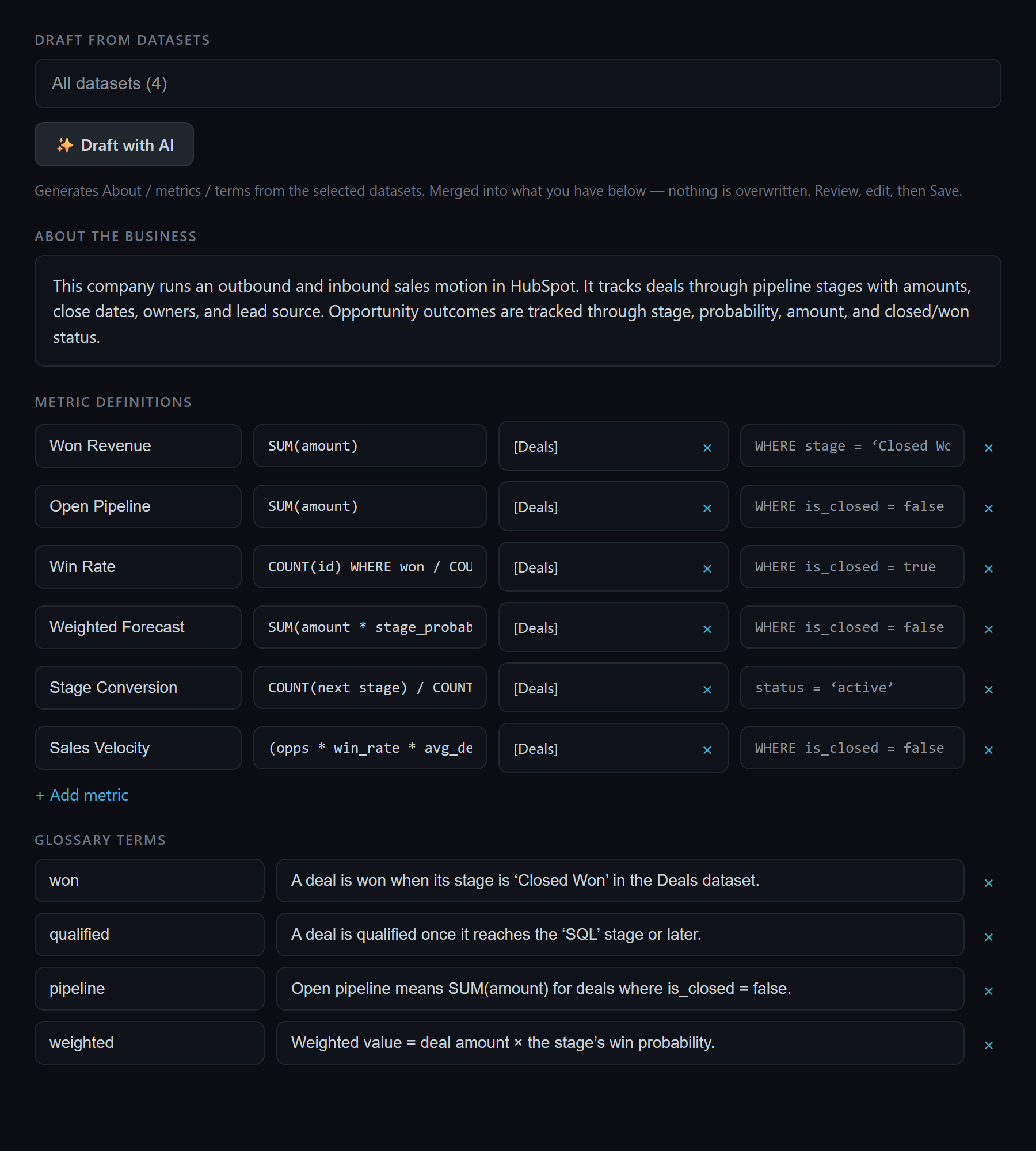
Write each metric down: the formula, the dataset, the filter. "Overdue balance = balance where days past due > 60." "Won = stage is Closed Won." Once it's written, the answer stops moving — because there's nothing left to guess.
Company Context is that place
In Quiriz, an admin fills in Company Context on /manage-org: a short description of the business, metric definitions, and a glossary. That block is injected into every answer and report, so "revenue", "overdue", and "win rate" mean the same thing for every teammate and on every surface — web, the Excel add-in, Sheets, and Slack. Same definition in, same number out.
The honest part
Consistency here doesn't come from the model being clever — it comes from your definitions being explicit. That's the point: the number is only as trustworthy as the definition behind it, and now the definition is written down where everyone can see it. Quiriz also grounds every filter against your real data and says "that value isn't in your data" rather than returning a tidy zero.
If you want the evidence behind all of this rather than the argument, the benchmark literature is blunt about it: models score above 70% on single-step questions and below 15% once an answer takes several steps, and the variance is worst exactly where definitions are ambiguous. We went through the numbers in how accurate AI actually is at analysing data.
Numbers your whole team can reproduce
Define your metrics once in Company Context and every question — web, Excel, Sheets, or Slack — returns the same answer. Free to start.
Try Quiriz free →