The AI Data Analyst: What It Is & Can It Replace a Human?
An honest look at the AI data analyst: what it does, what it can't, whether AI will replace data analysts, and the tools that do the job today.
"AI data analyst" means one of two things, depending on who's talking: the person with that job title, or the software creeping into their seat. This piece is about the software. It's the kind you hand a spreadsheet and a question, and it runs the analysis for you. So what can it actually do? Where does it fall over? And should anyone with "analyst" on their business card be nervous? Let's take all three honestly.
What is an AI data analyst?
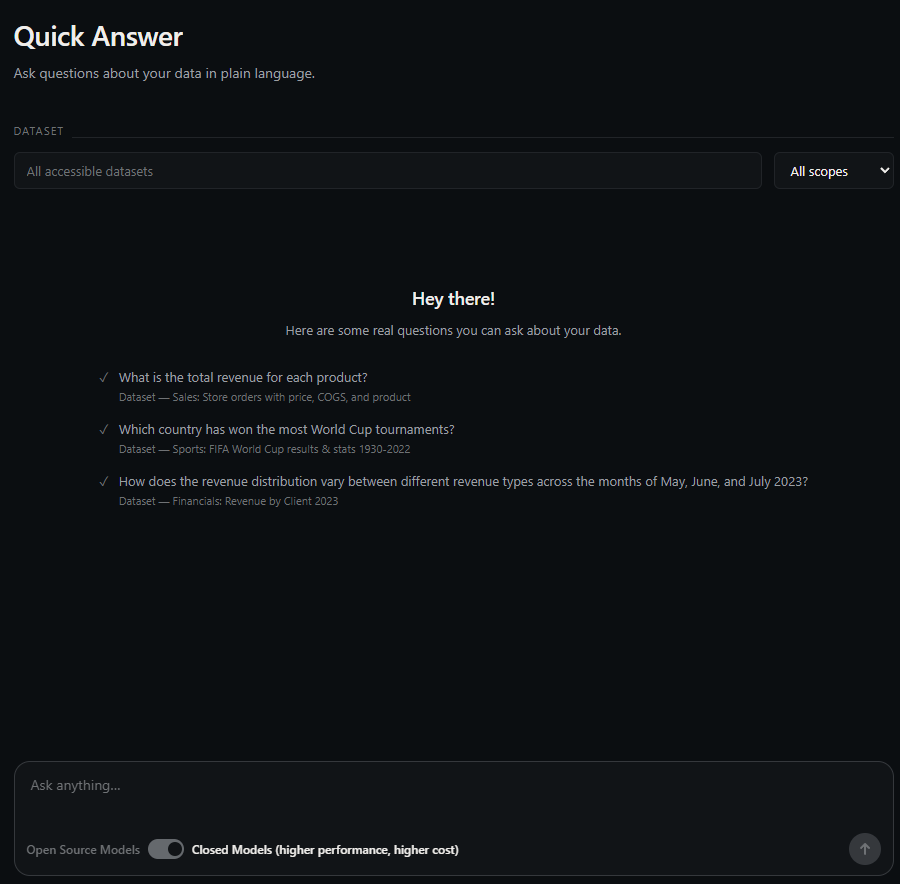
An AI data analyst is software that does the core job of a junior analyst using artificial intelligence. Point it at a dataset, ask something like "which customers churned last quarter?", and it chooses a method, runs the query against your real data, and comes back with an answer, a chart, and a short explanation you can read. Think of it as the querying-and-reporting engine, minus the SQL and the pivot tables. For the wider field this sits in, see our guide to AI data analytics.
What an AI data analyst does well
- Answers questions on demand. Ask in ordinary words, get numbers and charts back.
- Runs the repetitive analysis. The weekly report, the same breakdown by region, on tap.
- Explains its results. You get a summary, not just a wall of numbers.
- Scales one person's output. Nobody waits in a queue for the analytics team.
Can AI replace a data analyst?
Short answer: no. It changes the job rather than ending it. AI swallows the mechanical middle of analysis, the query-writing, the chart-building, the report-assembling. What it doesn't touch is the part that made analysts worth hiring in the first place:
- Deciding what to ask. The right question is a human judgment call.
- Judging trust. Knowing when an answer smells wrong and going back to check it.
- Understanding context. Why the numbers moved, and what the business should do about it.
- Owning the decision. Accountability doesn't outsource to a model.
So the honest outcome is augmentation. An AI data analyst lets one person cover what used to take a small team, and lets non-analysts answer the easy stuff themselves. That frees the human analysts for the hard questions, the ones that actually need judgment.
The benchmarks back that split up almost exactly. Across sixteen models tested on a set of real analytics tasks, accuracy on easy single-step questions sat between 66% and 81% regardless of which model was used — and every one of them scored under 15% on the multi-step questions. That is the mechanical middle being swallowed and the hard part being left alone, measured. The full picture is in how accurate AI is at analysing data.
AI data analyst tools
Different tools play the analyst role for different setups:
- Single file. ChatGPT Advanced Data Analysis, Julius.
- Inside a spreadsheet. Microsoft 365 Copilot, Gemini in Sheets.
- Shared across a team. A dedicated platform like Quiriz, with saved datasets, reports, and automatic refresh.
We compared ten of them in our review of the best AI tools for Excel data analysis.
How to put an AI data analyst to work
With Quiriz the analyst is shared, not stuck in one person's chat window. You load your datasets once. After that anyone on the team can ask a question, get an answer that really did run against the data, and publish it as a report. The data keeps itself current, so the analysis doesn't quietly rot between Mondays. For a one-off throwaway question, honestly, a general chatbot is quicker and you should just use one. A tool like this earns its keep when the same questions keep coming back and more than one person needs the answer.
Put an AI data analyst on your data
Ask questions in everyday language, get grounded answers and reports, shared with your team. Free to start.
Try Quiriz free →Frequently asked questions
What is an AI data analyst?
Will AI replace data analysts?
What are the best AI data analyst tools?
Is there a free AI data analyst?
Tool capabilities referenced are as published by each vendor as of July 2026 and change often.